Sourdough Discard Crackers
Crackers are the first thing to make with sourdough discard, because they use a lot of it at once and you can barely wreck them. No rise to get right, no crumb to worry about. You stir 4 things together, spread the paste thin, and bake it until it snaps. If your fridge jar is getting full, this is the afternoon it stops being a problem.
This assumes you’ve already got discard saved up. If you’re not there yet, what to do with sourdough discard covers the jar, how long it keeps, and everything else it’s good for.

What do you need for sourdough discard crackers?
4 things, and you have all of them: discard, a little flour, some fat, and salt.
| Ingredient | Amount | Notes |
|---|---|---|
| Sourdough discard | 1 cup (about 225 g) | Straight from the fridge is fine. Older, tangier discard works well here. |
| Flour | 1/4 cup (about 30 g) | All-purpose. It stiffens the paste so it spreads instead of runs. |
| Fat | 2 tablespoons | Olive oil, melted butter, or bacon fat. This is the flavor and the crunch. |
| Salt | 1/2 teaspoon in the dough, plus more for the top | Flaky salt on top if you have it. |
That’s the base. Everything else is optional and goes in the next section.

How do you make sourdough discard crackers?
Stir, spread, score, bake, snap. About 15 minutes of hands-on work, then the better part of an hour in and out of the oven and cooling.
- Heat the oven to 350 °F and line a baking sheet with parchment.
- Mix. Stir the discard, flour, fat, and salt together in a bowl until it’s a smooth, thick paste. It should be spreadable, like a stiff frosting, not pourable and not a dough you’d roll. If it’s runny, add flour a teaspoon at a time; if it won’t spread, add a splash of water.
- Spread it thin. Scrape the paste onto the parchment and spread it with a spatula or the back of a spoon until it’s about 1/16 inch thick, thinner than you think looks right. Even thickness matters more than shape. A second sheet of parchment on top and a rolling pin over it helps if the spatula fights you.
- Top and score. Scatter flaky salt and any seeds or seasonings over the surface and press them in lightly. Score the sheet into squares or rough diamonds with a knife or pizza wheel.
- Bake 35 to 45 minutes. At about the 10-minute mark, when the surface has set, run your knife along the score lines again so they stay defined. Then bake on. They’re done when the edges are browned and the center is dry and firm to a tap. Thin spots brown first, so from minute 30 keep an eye on it and pull individual pieces that are done, leaving the paler middle to finish.
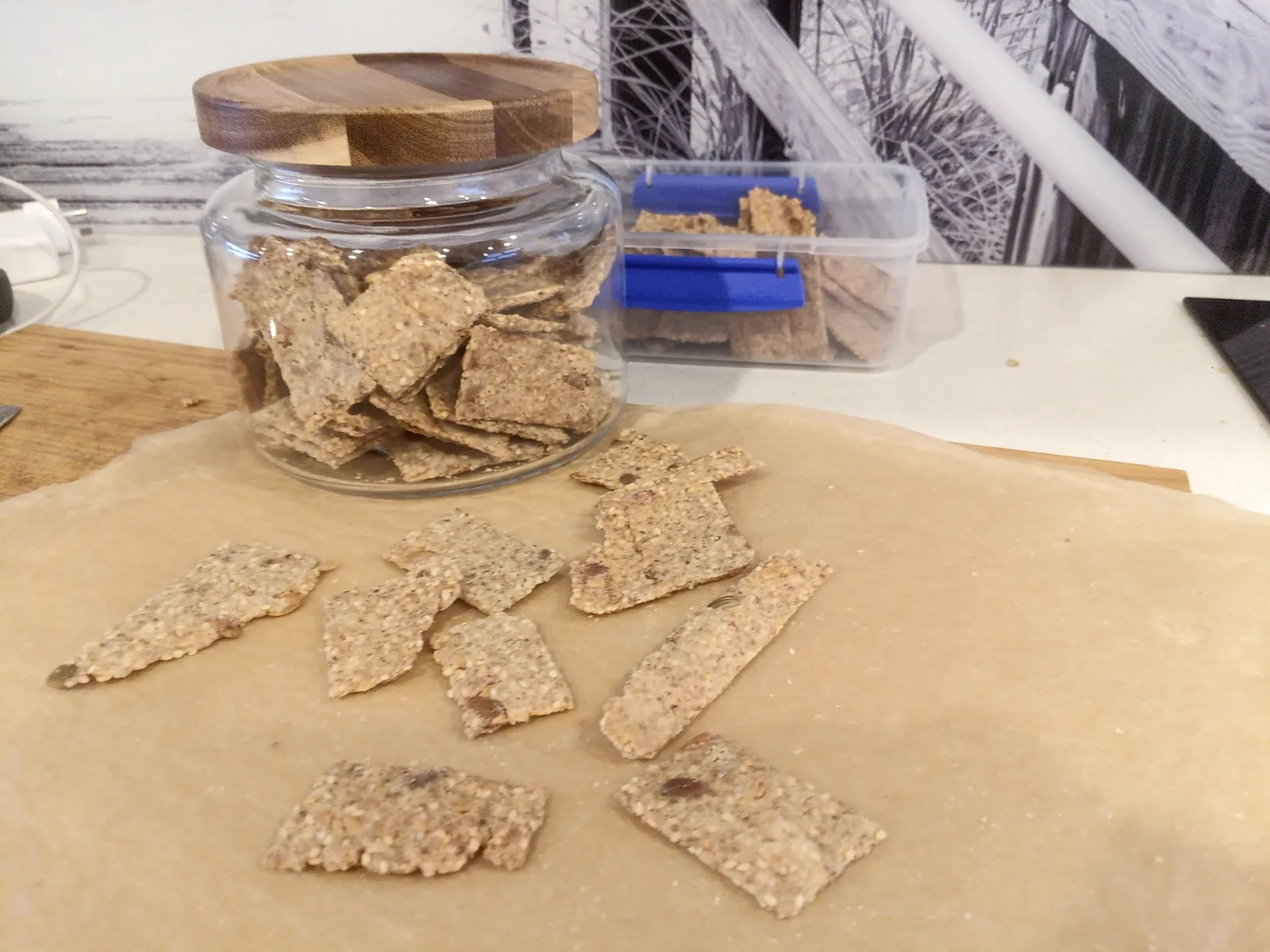
- Cool and snap. Let the sheet cool completely on the tray. It crisps as it cools. Then break along the score lines.
If the center still bends when it’s cool, it needed longer. Put those pieces back on the parchment and give them another 10 minutes at 350 °F, then check again.
How thin should you spread the paste?
As thin as you can get it without tearing, roughly 1/16 inch. This is the one thing that decides whether you get crackers or hardtack.
Spread too thick and the outside bakes hard while the inside stays chewy, so they never fully crisp and they go soft by the next day. Thin and even, and every piece dries through at the same rate and snaps clean. If your spatula leaves ridges, lay a second piece of parchment on top and roll it flat with a rolling pin or a straight-sided glass.
What can you add to sourdough discard crackers?
The base recipe is a blank canvas. Stir add-ins into the paste, or press them onto the top before baking:
- Everything bagel. Sesame, poppy, dried garlic, dried onion, flaky salt on top. The default for a reason.
- Herb and black pepper. A tablespoon of chopped rosemary or thyme and a good grind of pepper into the paste.
- Cheese. A quarter cup of finely grated parmesan or aged cheddar into the paste. Cut the added salt in half, the cheese brings its own.
- Seedy. 2 tablespoons of mixed sunflower, pumpkin, sesame, and flax into the paste, more on top. These are the sturdiest ones and travel well.
- Sweet-ish. Skip the top salt, brush with a little melted butter and a pinch of cinnamon sugar in the last 5 minutes. Good with cheese later.
Why did your crackers turn out soft, or hard, or burnt?
Almost every problem traces back to thickness or bake time.
- Soft the next day. Spread too thick, or pulled from the oven before the center dried. They’ll firm up with another few minutes in a low oven, and next time spread thinner.
- Hard, not crisp. Too thick, and often too little fat. Fat is what makes them shatter instead of resist. Use the full 2 tablespoons.
- Edges burnt, middle pale. Uneven spread, or the oven runs hot. Spread more evenly, drop to 325 °F, and pull the browned edge pieces early if you have to, leaving the middle to finish.
- Greasy. Too much fat, or the discard was very wet and you compensated with extra oil instead of flour. Add flour to stiffen a wet paste, not oil.
- Bland. Under-salted. Discard is mild. Salt in the paste and on top, and don’t skip the second one.
How do you store sourdough discard crackers?
Airtight at room temperature, about a week, up to 10 days. They’re at their best in the first few days and slowly soften after that. If they go a little bendy, 5 minutes on a tray in a 350 °F oven brings the crisp back. Don’t refrigerate them, they pick up moisture in there and soften faster.
Is sourdough discard safe to bake with?
Yes, from a healthy starter you’ve been feeding regularly, and as long as it’s baked, which these very much are. Raw flour and raw starter aren’t safe to eat, so no tasting the paste off the spatula. If you’re not sure your starter is healthy, the starter guide has the checks and the two signs that mean start over.
FAQ
Can you use discard straight from the fridge for crackers? Yes. Cold discard is fine here, no need to bring it to room temperature or feed it first.
How old can the discard be? Several weeks in the fridge. Older discard is more sour, which suits crackers well. If it’s grown mold or smells like acetone rather than sour, throw that jar out. And if the starter it came from has been sitting unfed for weeks, get that going again before you save discard from it.
Do sourdough discard crackers need yeast or baking soda? No. They’re not meant to rise. Adding leavening just puffs them and makes them bready instead of crisp.
Can you make them gluten-free? Yes, if your discard is from a gluten-free starter. Swap the quarter cup of flour for a gluten-free blend or fine oat flour. The texture is a touch more crumbly.
How much discard does one batch use? A cup, which is roughly what a daily-fed starter throws off in 2 or 3 days. Double the recipe onto 2 trays if your jar is fuller than that.
The next small step
Save your next 3 days of discard in one jar, then make a batch. Once you’ve done it once without measuring carefully and it still worked, you’ll stop thinking of discard as waste.
If you’d rather not have a discard jar to manage at all, that comes from keeping the starter small and fed once a week so it barely makes any. That’s the method in The Micro-Bakery Handbook (US$16.97), along with 3 loaves worked around a normal week, an artisan crust off a lidded casserole dish instead of a Dutch oven, and a version that works gluten-free.
More discard ideas: what to do with sourdough discard. And everything else fermenting on your counter: the fermentation troubleshooting guide.