Growing Green Onions Indoors: From the Water Glass to a Pot That Never Quits
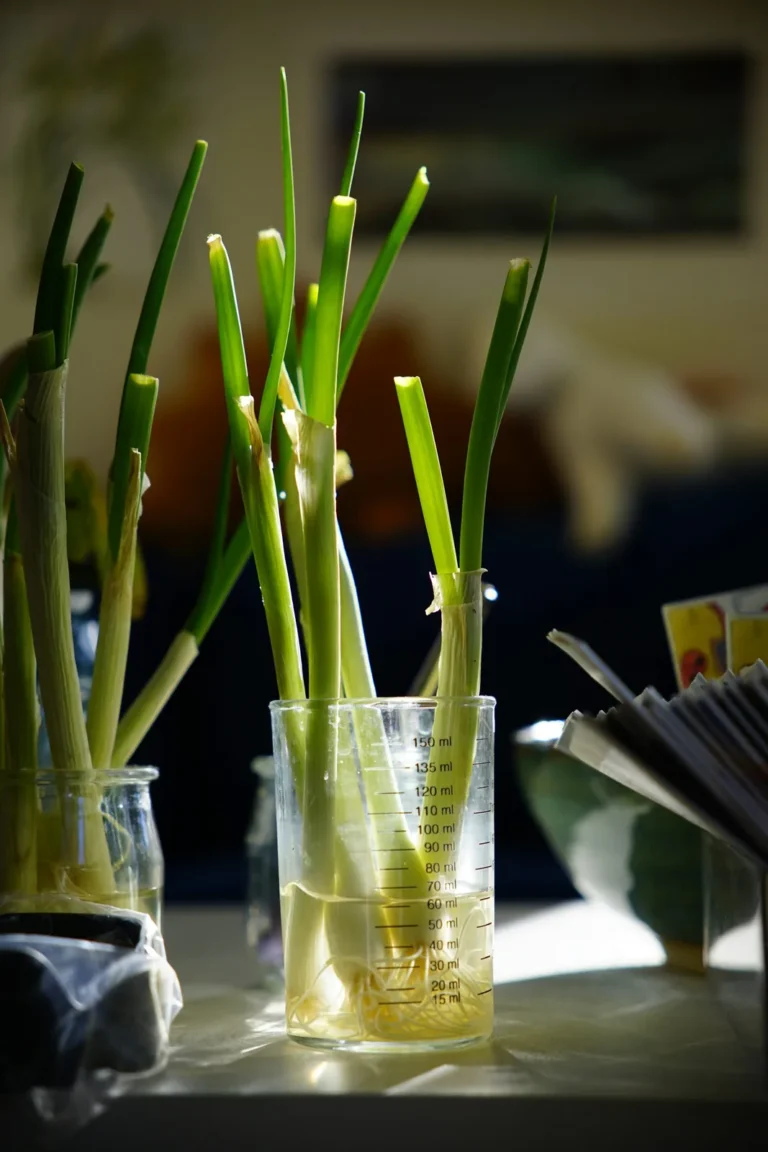
Everyone starts green onions the same way. You stand a leftover bunch of roots in a glass of water on the windowsill, the green shoots climb back up inside a week, and you feel like you’ve cracked something. So you do it again. By the third round the new growth comes back pale and thin as thread, the water smells like a pond, and the whole thing sulks.
That’s not you doing it wrong. That’s a glass of water doing exactly what a glass of water does, which is run out.
The fix isn’t a garden. It’s growing green onions indoors in a pot of soil instead of a glass of water. One pot on the same windowsill will hand you green onions more or less forever, and it costs about $8 to set up, most of that a bag of mix you’ll reuse on other pots.
If you’ve never regrown green onions before, start with the water-glass method and come back here once your bunch has roots on it. This guide picks up where the water stops delivering.
Why the water-glass trick runs out
Cut green onion roots sitting in water are living off savings. The white base has a store of sugars and starch packed into it from its time in the ground. When you cut the greens off, the plant spends that store pushing new shoots up. Water gives it something to stand in and a drink. It doesn’t give it food.
So the first regrowth is strong, because the account is full. The second is thinner. By the third or fourth cut the base has spent what it had, and it can’t photosynthesize fast enough through those skinny new leaves to top itself back up. You get weak growth, then rot, because now it’s a soft, tired plant sitting in stale water.
Two or 3 good harvests from a water glass is normal. Getting annoyed about it is optional. Move the plant to soil before it hits that wall and it never has to spend down to nothing.
Moving them to soil
The jump is easy and green onions are forgiving about it. Shallow roots, no drama.
Pot. Anything 6 inches deep and 6 inches across will hold 3 or 4 clumps. Deeper is fine. Wider beats deeper once you’re past 6 inches. It has to have drainage holes. A cheap plastic pot works exactly as well as a nice ceramic one here, the onions can’t tell the difference.
Mix. Ordinary bagged potting mix, nothing special. A small bag runs about $5 or $6 and fills several pots. Don’t use soil dug from the garden, it packs down hard in a container and stays too wet.
When. After the first water-grown harvest, while the base is still firm and white and the roots are an inch or longer. Sooner is better than later. Plant each base so the white part is buried and the growing tip sits right at the soil surface. Space them a couple of inches apart. Water it in, put it back on the windowsill, and leave it alone for a few days while it settles.
That’s the whole move. You’ve gone from a plant living on savings to a plant with an income.
Light: what a sunny windowsill actually gives you
Green onions want a bright windowsill. In the northern hemisphere that’s a south-facing window. In the southern hemisphere it’s a north-facing one. From here on I’ll just say sun-facing window, you know which one is yours.
A sun-facing window in summer gives them plenty. The same window in winter, or any window that looks onto a wall or the underside of the balcony above, gives them far less than it looks like it does. Your eyes adjust to dim light. Plants don’t grade on a curve.
If the greens come back tall, floppy, and leaning hard at the glass, that’s the plant telling you it’s short on light. 2 options. Move it to a brighter sill, or add a small clip-on grow light. The basic clip-on LED models run about $10 to $25 (Walmart and Home Depot, checked August 2026, for example a 13-watt Great Value clamp light at $14.92). Clip it to the sill 8 to 12 inches above the pot, run it 10 to 12 hours a day, and that’s it. You don’t need a big multi-head grow-light panel to keep one pot of onions in leaf.
The cut-and-come-again routine
Once they’re settled in soil, this is how you keep the supply running instead of killing it with kindness.
Cut, don’t pull. Scissors, and take the greens about an inch above the white base. Pulling tears the roots.
Never take the whole clump at once. Cut half, leave half. The leaves you leave behind are what feeds the regrowth. Scalp the plant and you’re back to the water-glass problem, a base with nothing to run on.
Feed it monthly. A half-strength dose of any liquid all-purpose fertilizer, once a month through the growing season. A potted plant can’t send roots out looking for more, so the food comes to it or it doesn’t come at all.
Rotate which clumps you cut. With 3 or 4 in a pot you’re always harvesting one while the others recover. You’ll have green onions on hand every week and the pot never looks bare.
When something goes wrong
New growth is thin and pale. Almost always light, sometimes food. Brighter spot or a clip light first. If the light is genuinely fine, start the monthly feed.
Leaf tips going yellow or brown. Usually watering. Green onions want the mix damp, not wet, not bone dry. Stick a finger in. Top inch dry, water until it runs out the bottom. Still wet, wait. A few yellowing lower leaves on an otherwise healthy plant is just age, pull those off.
White fuzz on the soil or around the base. That’s mold, and it means the surface is staying too wet with not enough air moving over it. Let the top dry out more between waterings, scrape off the worst of it, and crack a window near the pot. It’s a damp-air problem, not a disease.
Tiny black flies drifting up when you water. Fungus gnats. Same cause, wet surface. Let the top half-inch dry hard between waterings and they lose their nursery. They’re annoying, not a threat to the plant.
A hard round flower stalk shoots up from the middle. That’s bolting. Older green onions do it, especially after a temperature swing. The stalk is edible while it’s young, but the plant is putting its energy there instead of into leaves. Snap it off at the base as soon as you spot it and the plant usually goes back to making greens.
What one pot replaces at the store
A bunch of green onions runs about $1.20 to $2 depending where you shop ($1.89 at Lucky Supermarkets, less at discount grocers, checked August 2026). Most of what you buy is the white base and roots, which you cut off and throw away.
A 6-inch pot, a $5 bag of mix, and one bunch you were going to buy anyway gets you set up, call it $8, and you’ll use most of that bag of mix on other pots. If green onions turn up in your cooking most weeks, the pot pays for itself inside 2 months. After that it’s $60 to $80 a year you stop handing over for something that regrows on a windowsill.
It’s not going to change your life. Small, boring, pays off. That’s the whole case for it.
Start here
You don’t have to grow all your own food to be doing this properly. One pot of green onions that never quits is a real, finished thing. Start there, add the next thing, maybe a tray of microgreens, when you’re ready.
For what to grow, compost, and preserve in each month of the year, see the month-by-month apartment homesteading calendar.
If you want to see what else a sun-facing sill will carry, that’s most of our apartment homesteading guide. If you’d rather have the first month mapped out for you, grab the free guide, or the No-Land Homesteader’s Starter Kit (US$12.97) lays out a 30-day plan.
And if this saved you a few dollars or a bit of frustration, send it to someone who’s still buying green onions every week.