How to Grow Cucumbers in Containers, Start to Harvest
Miss a single day of watering, and a cucumber punishes you for it faster than any other crop on the balcony. Tomatoes sulk. Peppers wait you out. A cucumber vine with dry roots on a hot afternoon will drop flowers by evening, and there’s no fixing that batch of flowers once they’re gone. That’s not a reason to skip cucumbers, it’s just the one thing nobody tells you before you plant them in a pot instead of a garden bed.
Growing cucumbers in containers works fine, it just asks for a few things up front. Here’s the full setup: what to buy, how big a pot or planter you need, how to give a vine something to climb when you don’t have a garden bed to sink a stake into, and how to tell overwatering from underwatering before you lose a plant to either one.
Choosing a Variety and Starting
Skip the standard vining cucumber varieties sold for garden rows. A vine variety bred for open ground will happily run 6 feet (1.8m) or more, which is a lot of plant to support on a balcony. Look for bush or compact varieties bred specifically for containers: Bush Champion, Spacemaster, Salad Bush, or Patio Snacker. They still climb if you give them something to climb, they just don’t outgrow a container the way a full vine type does.
Start from a seedling if you can find one at a garden center, it saves 2-3 weeks over starting from seed and cucumbers don’t love being transplanted more than once. If you’re starting from seed, sow direct into the final pot rather than a seed tray. Cucumber roots resent disturbance, and a seedling moved twice loses time it won’t make up.
Grow 1 plant per pot. Cucumbers are heavy feeders with a wide root system, and 2 plants sharing a container both end up smaller than 1 plant grown alone.
What Size Pot or Planter Does a Cucumber Need?
A cucumber needs a genuinely large container, not a compromise size. The same 20-25 liter (5-7 gallon) minimum that applies to balcony tomatoes applies here too, and bigger performs better. A half-wine barrel or a 30-liter grow bag will outgrow a 20-liter pot’s plant by harvest time.
A long planter box works as well as a round pot if it holds that much soil at that depth, and most rail and window-box planters don’t. Check the liter or gallon figure on the label rather than the length, since a shallow planter can look roomy along the top and still leave cucumber roots with nowhere to go.
Depth matters as much as volume. Aim for at least 12 inches (30cm) of soil depth so the root system has somewhere to go, since a wide, shallow pot with the same volume as a deep one still leaves cucumber roots cramped. Whatever you use needs drainage holes, no exceptions, standing water in the base is the fastest way to lose a cucumber plant to root rot.
If you’re working out what else fits your specific containers, the pot-size cheat sheet covers 10 other crops by depth, cucumbers just need more room than anything on that list.
Light and Siting
Cucumbers want full sun: 6 or more hours of direct light a day, your single sunniest spot, the same threshold the balcony guide sets for tomatoes in the same full-sun group. Less than that and you’ll get a leafy plant with few flowers and fewer fruit.
Position matters too. Cucumbers want warmth and shelter from wind at the same time, which is a harder combination on an exposed or high balcony than it sounds. If your space is consistently windy, expect more work protecting the vine and possibly a smaller harvest, that’s a real limit of the space, not a skill problem. The full breakdown of reading your own balcony’s sun and wind is in the balcony vegetable garden guide if you haven’t assessed your space yet.
Support and Staking Without a Garden Bed
This is the part that trips people up, because every staking guide assumes you can drive a stake into the ground. You can’t do that in a pot on a balcony floor, so the stake has to stand on its own.
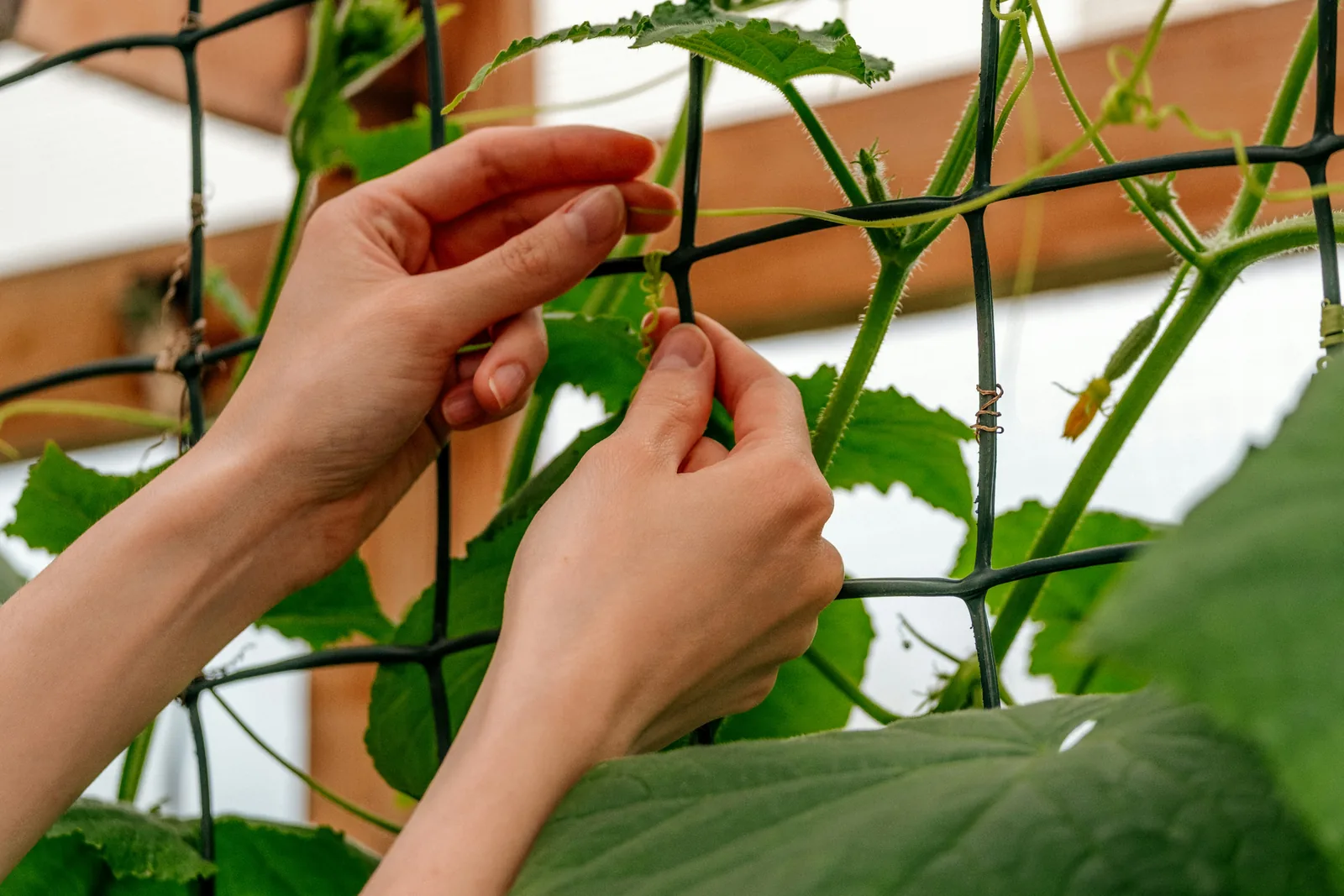
Growing a cucumber vertically is most of the point in a small space: a vine trained upward takes a fraction of the floor area it takes sprawling, and the fruit stays off wet soil. A compact bush variety runs a shorter vine than a full vining type, so size the support to the plant and guide the first growth onto it rather than buying height the vine will never reach. Which crops are worth training up, and which only look the part, is covered in the vertical vegetable garden guide. This section is about the support itself, when a pot is the only thing you have to anchor it to.
A few setups that work without a garden bed:
- A freestanding tomato cage or cone trellis, sized for the pot, pushed into the potting mix at planting time before the roots fill in around it. Cheap, and it stands on its own weight plus the soil packed around the base.
- A trellis panel leaned against a wall or railing, angled back rather than mounted vertically. No drilling, and the lean itself adds stability that a straight-up panel doesn’t have.
- An obelisk-style plant support, the kind sold for climbing beans and sweet peas, works just as well for a bush cucumber variety trained to climb rather than sprawl.

Whatever you use, set it up when you plant, not once the vine’s already sprawling across the balcony floor. Training a cucumber vine onto a support after the fact means untangling tendrils that have already grabbed onto something else, and they grab onto everything.
Feeding
Cucumbers are heavy feeders, more so than most container vegetables, because they’re producing fruit continuously through the season rather than once. Follow the same schedule as balcony tomatoes: once the plant is established and growing (about 4-6 weeks after planting), feed with a balanced liquid fertilizer every 2 weeks. Once flowering starts, switch to a higher-potassium feed to support fruit development instead of more leaf growth.
Container soil runs out of nutrients faster than garden soil because watering leaches them out, and a cucumber vine in a pot that’s only fed occasionally will produce a handful of small, bitter fruit instead of a steady harvest.
Watering: Signs of Overwatering and Underwatering
This is where cucumbers separate themselves from the more forgiving balcony crops. They need consistently moist soil, not wet, not dry, and they’ll tell you fast when you get it wrong in either direction.
Signs your cucumber plant is overwatered:
- Yellowing that starts at the base of the plant and moves up, rather than showing up on new growth first
- Soft, almost translucent stems near the soil line
- Wilting leaves even though the soil is clearly wet, this is the one that fools people, since a droopy plant looks thirsty
- A sour or musty smell from the soil surface
- Edema: small blister-like bumps on the underside of leaves, caused by the plant absorbing more water than it can use
Signs your cucumber plant is underwatered:
- Crisp, dry leaf edges rather than soft yellowing
- Soil visibly pulling away from the sides of the pot
- Wilting that recovers within an hour or two of watering (an overwatered plant’s wilt doesn’t bounce back that fast)
- Slow growth and small, sometimes bitter fruit
How to tell them apart: don’t trust the leaves alone, check the soil. Push a finger in to the second knuckle, about an inch (2.5cm). Comes out damp with soil clinging to it, the plant doesn’t need water no matter how it looks. Comes out dry, water it thoroughly until it runs from the drainage holes. The full method (and why the finger test beats every gadget sold for the job) is in the overwatering guide, and it applies to cucumbers in a pot exactly the same as it does to a houseplant on a windowsill.
Why containers make this worse than a garden bed. A pot holds a fixed, small volume of soil. In a garden bed, extra water disperses sideways into the surrounding ground; in a pot, it has nowhere to go but down and out the drainage holes, or nowhere at all if there aren’t any. That means a container cucumber goes from “fine” to “waterlogged” faster than the same plant in open ground, and dries out faster too on a hot day. A raised saucer that never sits in standing water, decent pot size, and the finger-test cadence above are the 3 things that keep this manageable.
On a hot, sun-facing balcony in summer, that can mean checking the soil daily. Check it, don’t just water on a schedule, since a cucumber’s water needs shift with the weather more than most crops on this site.
Common Problems
Bitter fruit. Usually inconsistent watering, a plant that goes dry then gets soaked produces more of the bitter compound (cucurbitacin) than one kept evenly moist. Irregular feeding and heat stress make it worse. Consistent watering fixes most bitter-cucumber problems before you touch anything else.
Blossom drop. Flowers forming and then falling off before they turn into fruit. Heat stress, inconsistent watering, and poor pollination (fewer bees visit a balcony than an open garden) are the usual causes. Hand-pollinating with a small paintbrush, moving pollen from a male flower to a female one, fixes the pollination half of the problem if you’re short on visiting insects.
Aphids. Check the undersides of leaves weekly. Small colonies wipe off by hand or with a strong spray of water; a bigger infestation calls for insecticidal soap.
Powdery mildew. A white, dusty coating on leaves, more common in still, humid air than in a breeze. Space plants so air moves around them, and water the soil rather than the leaves.
Harvest
Pick cucumbers small and often rather than letting them grow large. A bush variety cucumber is usually ready at 6-8 inches (15-20cm), well before it reaches the size of a supermarket cucumber. Leaving fruit on the vine to grow bigger signals the plant to stop producing new flowers, so frequent small harvests get you more cucumbers over the season, not fewer. Check the plant every 1-2 days once it starts fruiting, a productive vine can hide a fruit you missed until it’s oversized and seedy.

FAQ
Can I grow cucumbers in a pot without a trellis?
Yes, if you choose a genuinely bush or compact variety and let it sprawl rather than climb. It takes up more floor space that way, and fruit sitting on damp soil is more prone to rot, so a trellis is still the better setup on a balcony where floor space is tight.
How many cucumbers will one plant produce?
A well-fed, consistently watered container cucumber can produce 10-20 fruit over a season, depending on variety and how early you start picking. Inconsistent watering or feeding cuts that number fast.
Why are my cucumber leaves turning yellow?
Check the soil before assuming it’s a feeding problem. Yellowing that starts low on the plant with wet soil underneath is overwatering, not a nutrient deficiency, see the watering section above before you reach for fertilizer.
Do cucumbers need a male and female flower to fruit?
Most traditional varieties do; many modern container and bush varieties are self-fertile or produce mostly female flowers. Check the seed packet or plant tag, and hand-pollinate with a small paintbrush if fruit keeps dropping and you’re not seeing bees.
Can I grow cucumbers in a planter box instead of a pot?
Yes, as long as the planter gives each plant 20-25 liters (5-7 gallons) of soil and about 12 inches (30cm) of depth. Volume and depth are what matter, not the shape, so a deep trough planter is fine and a shallow rail planter isn’t. The 1 plant per pot rule from earlier is really a 1 plant per 20-25 liters rule, and most long boxes hold one plant’s worth of soil no matter how much room the length suggests.
A cucumber in a pot is more work than a tomato and less forgiving than a pepper, but a properly sized container, a support set up on day one, and the finger test before every watering will get you a real harvest without a raised bed anywhere in sight. If this is your first container vegetable, the free windowsill guide is a more guaranteed pathway to a successful first crop than taking on the most demanding crop on the balcony.