Companion Planting Herbs in Pots: What Works, What Takes Over
Straight up: our own advice on this site has been that separate pots are the practical approach for herbs. That’s still the right default. But “the right default” isn’t “always true,” and there’s a real, narrower answer underneath the blanket advice: some herbs genuinely do share a pot well, some will limp along until one of them gives up, and one or two will take the whole pot over and leave you wondering what happened to the others. This is the difference broken down properly, not a pairing list copied from every other gardening site.
Can You Plant Different Herbs in the Same Pot?
Sometimes, yes. It comes down to three things matching closely enough: how much water they want, how much light they need, and how aggressively their roots grow. Get those three things wrong and one herb quietly starves the others of water, light or space while looking perfectly fine itself. Get them right and a shared pot genuinely works, saves you counter space, and looks better than four separate plastic pots lined up on a windowsill.
This assumes you already know how to grow the individual herb; if you don’t, our guide to growing herbs indoors covers that first. What follows is only about whether two herbs you can already grow can share a root zone.
The mistake most “companion planting” content makes is treating this as a matter of flavor pairings: basil goes with tomatoes, so basil must go with anything Italian. Flavor has nothing to do with whether two plants can share a root zone. Physiology does.
The Three Things That Matter: Water, Light, Root Habit
Water. Herbs split roughly into two camps. Mediterranean herbs (rosemary, thyme, oregano, sage, marjoram) evolved in dry, rocky soil and want to dry out almost completely between waterings. Soft-leaf herbs (basil, parsley, cilantro, chives) evolved in richer, damper ground and want soil that stays consistently moist. Put one from each camp in the same pot and you’re stuck: water enough for the basil and you’ll rot the rosemary’s roots; water sparingly enough for the rosemary and the basil will wilt and sulk.
Light. Most culinary herbs want a genuinely sunny spot, but the amount varies. Basil wants 6 to 8 hours of direct sun and gets leggy and pale without it; mint and parsley tolerate a few hours less. Pairing a full-sun herb with a partial-shade one in the same pot usually just means one of them underperforms wherever you end up putting the pot. If your whole window is on the dim side to begin with, our guide to growing food in low light covers which crops still perform before you worry about pairing anything.
Root habit. This is the one that often catches people out. Most herbs stay in a tidy clump. A handful spread aggressively by runner, sending roots sideways under the soil to colonize the whole pot regardless of what else is planted there. This is the single biggest cause of a shared pot going wrong, and it’s covered on its own below.
Herbs That Genuinely Share a Pot Well
Two combinations do most of the heavy lifting here, because they group herbs with matching water needs rather than matching flavors:
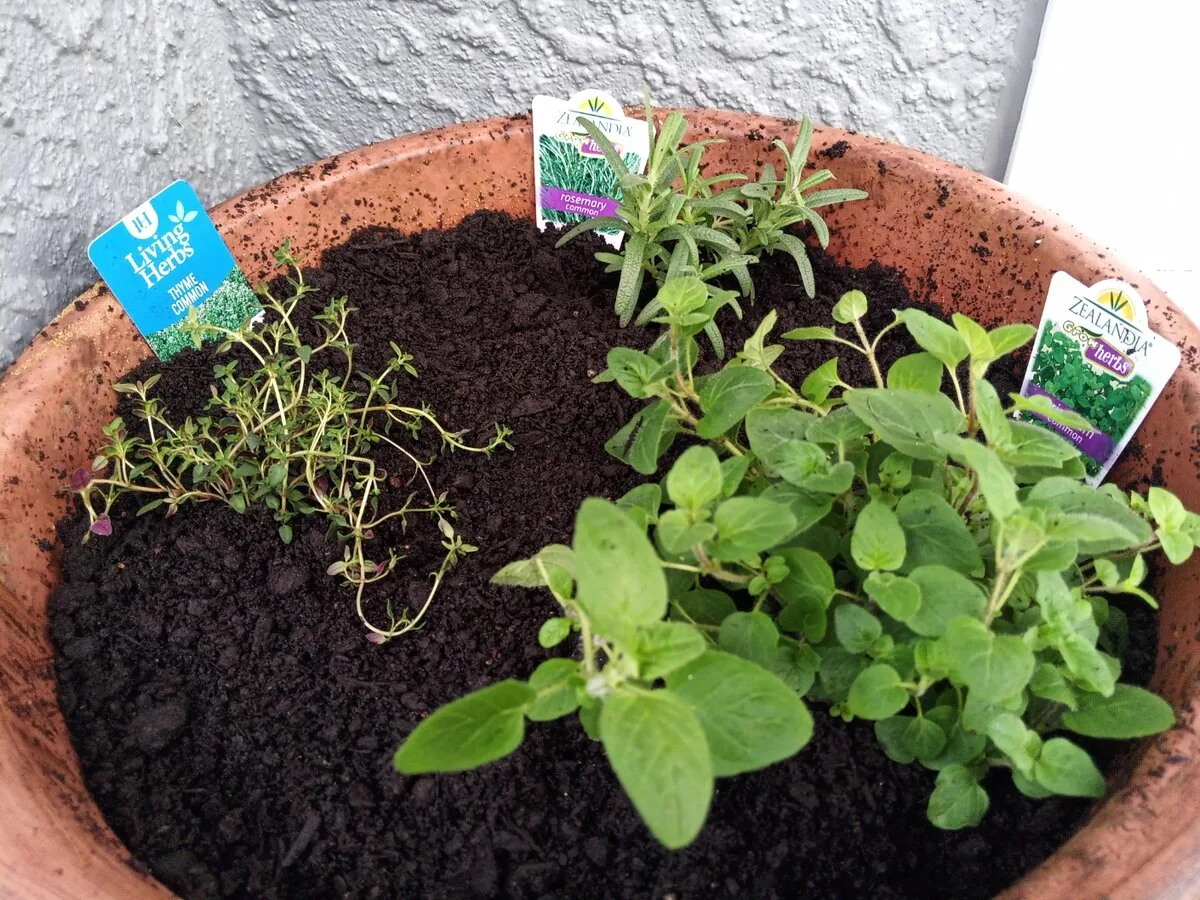
The dry group: rosemary, thyme, oregano and sage. All four want the same lean, fast-draining soil and the same let-it-dry-out watering rhythm. Sage grows larger than the other three, so give it the wider side of the pot and expect to trim it back so it doesn’t shade its neighbors.
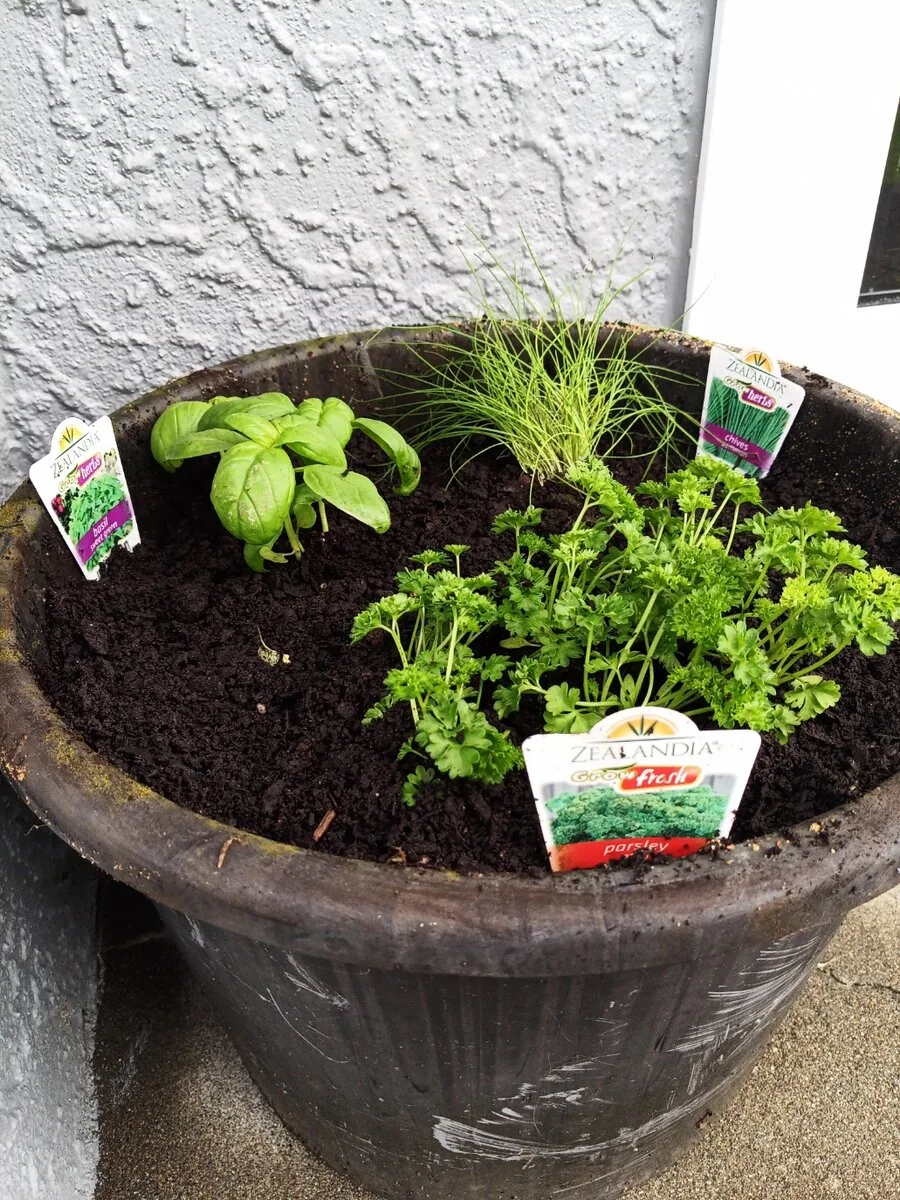
The steady-moisture group: basil, parsley and chives. All three want soil that stays evenly damp and a rich potting mix rather than the gritty mix the dry group prefers. Basil is the thirstiest of the three; check it first if you’re deciding whether the whole pot needs water.
Crossing the two groups is where most shared pots fail. Basil next to rosemary is the classic mismatch: one wants to dry out, the other wants consistent moisture, and there’s no watering schedule that keeps both happy at once.
Herbs That Should Always Have Their Own Pot
Mint spreads by runner, sending roots sideways under the soil to claim new ground, the same way a strawberry plant sends out stems above it. In open ground this is a nuisance; in a shared pot, it’s fatal to whatever’s planted alongside it. Mint doesn’t compete with a neighboring herb so much as physically occupy the space it was growing in.
Lemon balm spreads differently but ends up just as unwelcome. It doesn’t run the way mint does; it’s a clumping plant that spreads mainly by seeding itself vigorously once it flowers, and the clump itself gets large and woody fast. In a shared pot it simply out-bulks its neighbors for light and root space.
This is the one point where the advice on our herbs-indoors guide and this page need to agree completely: mint and lemon balm go in their own pot, always, no exceptions, no clever workaround, whatever else is or isn’t planted with them.
How Big Does a Shared Herb Pot Need to Be?
Our balcony guide puts a single herb’s minimum at 1 to 1.5 gallons (4 to 6 liters) per plant, and adds that herbs don’t like being crowded. That figure is already per-plant, so a shared pot doesn’t get a volume discount for sharing; if anything, give it a bit more room than the bare sum, since a cramped pot is exactly the crowding that number is warning against.
As a working range: three herbs from the same water-needs group need a pot delivering at least 4 to 6 gallons (15 to 22 liters), which in practice means something in the 16in (40cm) diameter range at a genuine 8 to 10in (20 to 25cm) depth, not a shallow bowl of the same width (a 16in-wide, 8in-deep tapered pot works out to roughly 5 gallons, or 18 liters; go to 10in deep and the same width holds closer to 6 gallons, or 22 liters). That’s noticeably bigger than the single-herb minimum, and it’s the step most shared-pot attempts skip, cramming three plants into a pot sized for one and wondering why growth stalls after a few weeks. If you’re starting from a pot you already own rather than buying one to fit, our pot-size guide shows what fits in the pot you already own, herbs included, which is a faster gut-check than doing the liter math yourself every time.
Five Container Combinations That Work (and Two That Don’t)
| Combination | Verdict | Why |
|---|---|---|
| Rosemary + thyme + oregano | Works well | Same dry Mediterranean profile, same light needs, similar mature size |
| Sage + thyme | Works well | Same dry profile; give sage the wider side of the pot as it grows larger |
| Oregano + marjoram | Works well | Close botanical relatives with near-identical water, light and soil needs |
| Basil + parsley + chives | Works, needs watching | Same moisture needs; basil is thirstiest, check it first before assuming the pot needs water |
| Parsley + chives | Works well | Both tolerate a touch less sun than basil and share the same steady-moisture preference, a safer two-herb version of the trio above |
| Cilantro + basil | Caution | Similar water needs, but cilantro bolts fast in heat and needs frequent replacing, which disturbs basil’s roots each time; better as neighboring pots than a true shared one |
| Basil + rosemary | Don’t | Opposite water needs; one will always be wrong for the other |
Does Companion Planting Repel Pests in a Pot?
Mostly not, and not enough to plan around. Pest-repellent claims attached to specific herb pairings are common in companion-planting content, but most trace back to garden lore rather than controlled testing, and almost none of it has been tested in a container specifically, where airflow, soil volume and pest access are all different from an open bed. We’re not naming or debunking individual claims here because we don’t have a container-specific source for any of them either way, and repeating an unsourced claim just to knock it down isn’t more honest than repeating it straight. Choose herbs that share a pot because their water, light and root needs match, the way this page has laid out. If a pairing happens to help with pests too, treat that as a bonus you got for free, not the plan you built around.
What Goes Wrong in a Shared Pot, and How to Tell Early
Week 2: one herb looks droopy or crisp while its neighbors look fine. That’s a watering mismatch, not a disease. Check whether you’ve paired a dry-loving herb with a moisture-loving one, and see our guide to overwatering if the droopy one is sitting in soggy soil rather than dry.
Week 6: one herb is visibly bigger and the others have stalled or gone yellow. That’s root competition, usually because a vigorous grower like sage or basil has out-competed a smaller neighbor for space and nutrients.
Week 12: everything in the pot has slowed down at once, even the herb that was thriving earlier. That’s the pot itself running out of room; roots have filled the available soil and need dividing into separate containers, not more fertilizer.
The rescue at any of these stages is the same: split the pot rather than trying to nurse a failing combination along. A struggling herb moved to its own pot usually recovers within a couple of weeks; one left to compete rarely does.
FAQ
Can basil and mint be planted together?
No. Mint’s spreading roots will take over the pot regardless of what’s planted with it, basil included. Keep mint on its own permanently.
What herbs should never be planted together?
Any pairing that crosses the dry group (rosemary, thyme, oregano, sage) with the steady-moisture group (basil, parsley, cilantro, chives) is a mismatch, because there’s no single watering schedule that suits both. Mint and lemon balm shouldn’t be planted with anything at all.
Is a bigger pot always better for a shared herb garden?
Bigger helps up to a point, but width matters more than depth for most herbs. A wide, moderately deep pot lets three compatible herbs spread their root zones without crowding; a tall, narrow pot doesn’t solve the same problem.
Do herbs planted together taste different or grow faster?
No good evidence for either. Any benefit from a good pairing is about the plants not competing for water, light or space, not a flavor or growth boost from proximity itself.
The next small step: if you’re not sure how to grow the individual herb in the first place, start with our indoor herb guide before deciding what to pair it with. If growing anything without a yard is new to you at all, our apartment homesteading pillar is the wider starting point.
Want the free guide with 10 things you can grow with no garden and no experience? Get it here.